

Company thesis
Meta's $64.6B quarter: the ad machine funds the superintelligence bill
Revenue +26%, operating margin 20%, and a shopping-led AI assistant that Meta says will one day out-earn its apps.
Muse-assisted drafting; facts and all eight translations reviewed by the owner. This is not an independent model review. AI-assisted draft (aiAssisted=true) prepared for human review; not an independent audit. Meta's personal AI assistant “Muse” is unrelated to the AI assistant that helped draft this article.
The quarter in one paragraph
Meta reported third-quarter 2026 revenue of $64.6 billion, up 26% year over year, with Family daily active people at 3.64 billion and ad impressions up 10% against a 14% rise in average price per ad. The core advertising engine is visibly accelerating.
The rest of the release tells the cost story: total costs and expenses reached $51.6 billion, up 68%, leaving operating income at $13.0 billion, down 37%, and the operating margin at 20% versus 40% a year earlier.
The $9.89B line item
The single biggest line in that cost jump is a $9.89 billion charge tied to Meta's August 2026 agreement with 52 state attorneys general to resolve teen-mental-health litigation, with total payments of up to about $18.59 billion. Strip it out and the quarter looks different: operating income would have been $22.9 billion and diluted EPS $7.40 instead of the reported $3.83.
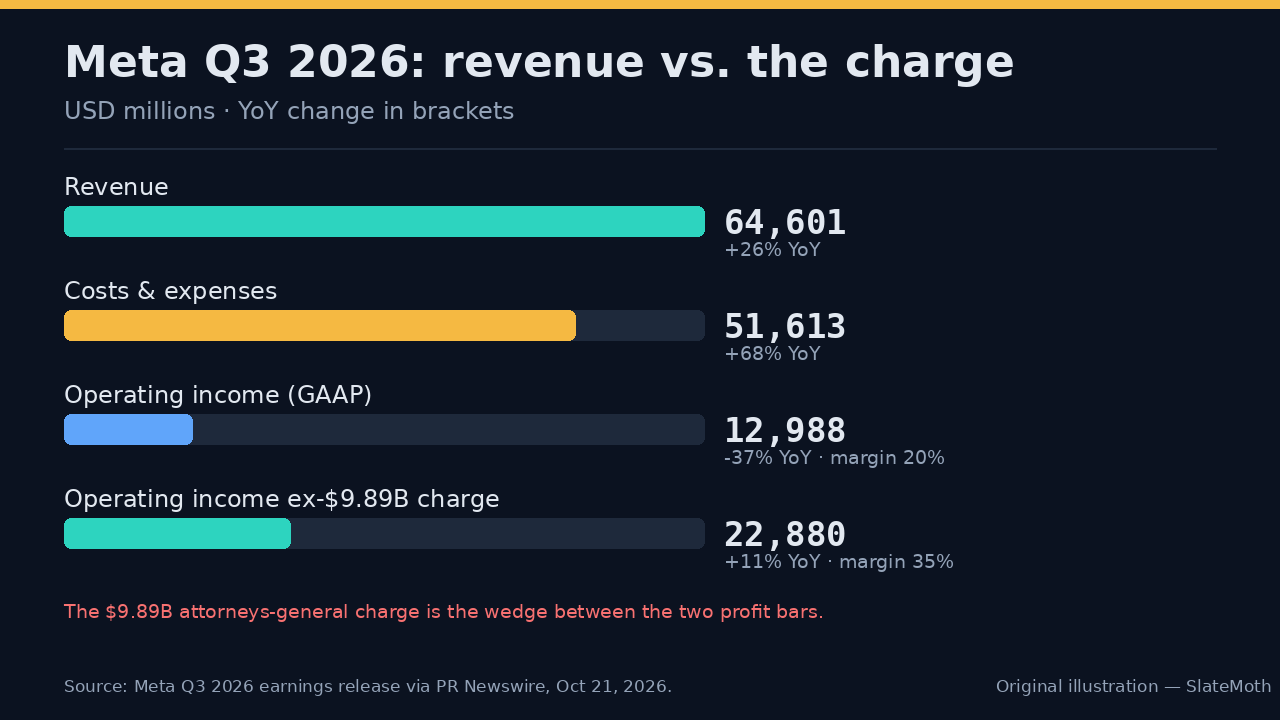
That adjustment is not accounting theater — it is the difference between a quarter that missed and one that beat. But the charge is a real commitment, and Meta warned that more youth-related trials are scheduled in the coming months in the United States.
Guidance: spend more, guide higher
For the fourth quarter Meta guided revenue of $73–76 billion, and it raised the full-year 2026 expense outlook to $175–179 billion to absorb the legal charge. Capital expenditure guidance narrowed to $135–145 billion — narrowed upward, from $130–145 billion — while Reality Labs losses are now expected at $18–19 billion for 2026, improving toward about $15 billion next year.
The pattern is familiar by now: AI investment keeps pulling the spending line up faster than revenue, and management's answer is that AI-driven gains in engagement and ad monetization justify it. Meta declined to give a full-year 2027 revenue outlook, but said it expects aggressive investment to continue.
A new share class for the AI buildout
The board also approved a new publicly listed, non-voting Class C common stock, effective January 19, 2027, with a one-time stock dividend of one Class C share for every Class A and Class B share outstanding. The market price is expected to reflect a two-for-one split; no shareholder's voting power changes.
The stated purpose is capital optionality: raising money, paying employees, and funding acquisitions for the AI transformation without diluting founder control. A Founder Alignment Agreement with Mark Zuckerberg governs his sales of the new shares and his service at the company. The market, unsurprisingly, read it as future dilution risk.
Muse: 10 million accounts in six weeks
The product story of the quarter came on the earnings call, where Zuckerberg said more than 10 million people in the United States and Canada had set up Meta's personal AI assistant Muse within about six weeks of launch. (Meta's assistant shares its name with the AI assistant that helped draft this article; the two are unrelated.) About 25% of those who set it up now use it daily, and shopping has emerged as the top use case.
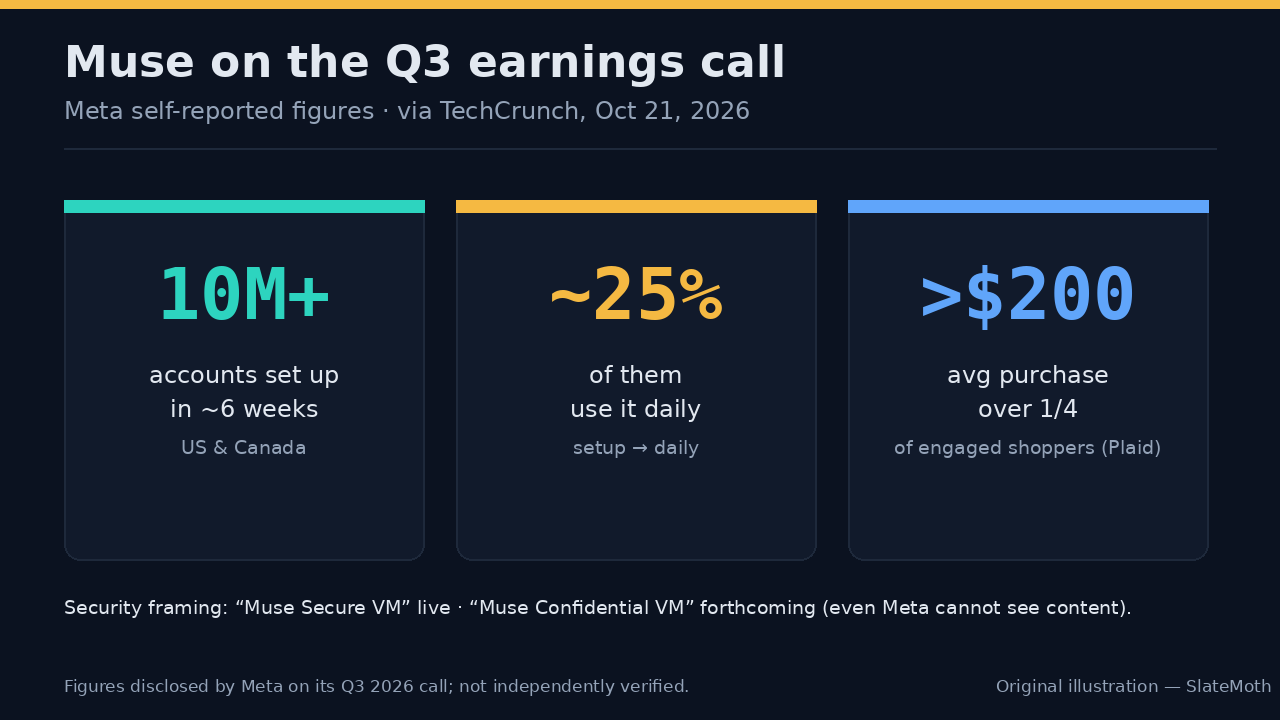
The commerce numbers are the striking part: more than a quarter of Muse's engaged users who shop through the agent average over $200 per purchase, via a Plaid connector that Zuckerberg said had shown activity like nothing Plaid had seen on any other service. Meta says Muse has reached product-market fit, and the monetization plan is now explicit: keep it free for most users, take a percentage of the commerce it touches, and charge power users, businesses, and employers for advanced models and tokens.
The security framing matters as much as the revenue framing. Muse runs with a “Muse Secure VM” for data protection, and a forthcoming “Muse Confidential VM” is designed so that even Meta cannot see user content — a direct bid for the trust that agentic shopping requires. Zuckerberg also said Meta expects to improve Muse's compute cost efficiency by more than 10x over the next year, the stated condition for profitability once the revenue lines are at scale.
What the market heard
The market heard the bill, not the story. Meta shares fell nearly 7% on October 22, closing at $648.85 against a previous close of $697.52, as investors weighed the raised capex floor and the Class C dilution overhang against the revenue beat. The quarter's message in one line: the ad business is funding personal superintelligence, and the funding is getting expensive.
The honest read is that this quarter reprices Meta from an ad company dabbling in AI into an AI-infrastructure company that happens to own the world's best ad business. Muse's shopping-led traction gives Zuckerberg something his capex skeptics rarely get: a revenue line with a shape — a commerce take rate plus subscriptions plus enterprise — attached to the spending. Whether that line scales faster than the $135–145 billion capex line is now the entire investment question.
Sources and further reading
Source records were reviewed by the owner; no independent factual or model review is claimed.
- Meta Q3 2026 earnings release (PR Newswire)
Meta Platforms, Inc. via PR Newswire
Recorded publication date ·
Recorded verification time ·
- TechCrunch earnings-call report
TechCrunch
Recorded publication date ·
Recorded verification time ·
- Finnhub market data
Finnhub
Recorded publication date ·
Recorded verification time ·
- TradingView / StockStory market commentary
TradingView / StockStory
Recorded publication date ·
Recorded verification time ·