

AI infrastructure
Intel's D270 bets that AI inference is a memory problem, not a speed problem
At the OCP Global Summit, Intel turned its long-teased Crescent Island project into a product line — and argued that for agentic AI, how much memory fits on a card matters more than how fast each byte moves.
Muse-assisted drafting; facts and all eight translations reviewed by the owner. This is not an independent model review. This article was written with AI assistance and has not been independently reviewed. Figures are Intel's published specifications and clearly labeled third-party estimates; no independent benchmarks exist yet.
What happened
On October 12, 2026, at the Open Compute Project Global Summit in San Jose, Intel gave its long-teased inference accelerator, codenamed Crescent Island, a real product name: the Intel GPU D-series, led by the first model, the GPU D270. The announcement, carried in an official Intel press release, also introduced new Xeon 6+ rack designs and an open software push aimed at what Intel calls the agentic AI era.
The headline numbers are deliberately about memory rather than raw speed: up to 480 GB of LPDDR5X memory, 1.5 TB/s of memory bandwidth, and 1.3 petaflops of FP8 compute, all inside a 350-watt, air-cooled PCIe card. The framing line, repeated by executives at the event, was 'put every prompt in its place' — match each AI workload with the cheapest hardware that can do it well.
The specs, and the tradeoff
The D270 is the first chip on Intel's Xe3P architecture. Technical reporting on the announcement details 32 Xe3P cores and 256 XMX matrix engines — the units that do the matrix math behind neural networks — with graphics and ray-tracing circuitry removed to make room for compute. The card uses a standard PCIe form factor and passive air cooling, so it slides into data centers that already exist, with no liquid-cooling loops or special racks.
Memory comes in two tiers, and the distinction matters. Intel's own branded card ships with 160 GB of LPDDR5X; the design allows server partners to build their own cards with flexible configurations up to 480 GB. Intel says a single card can host models of up to about 300 billion parameters, and an eight-card system can scale past one trillion.
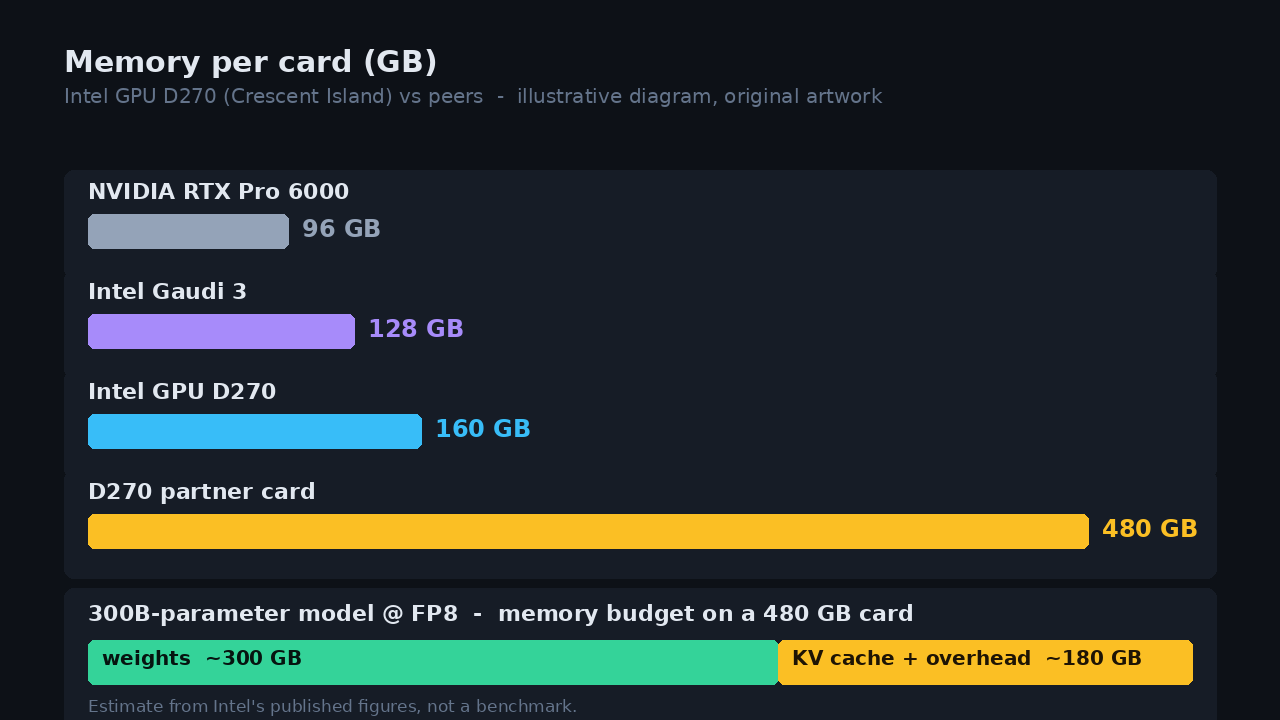
The tradeoff is explicit: LPDDR5X is far cheaper per gigabyte, easier to buy, and much more power-efficient than the stacked HBM used in flagship AI chips — but it is also much slower. Gaudi 3, Intel's own current inference card, carries 128 GB of HBM2e at 3.7 TB/s; Nvidia's RTX Pro 6000 pairs 96 GB of GDDR7 with roughly 1.8 TB/s. The D270 offers up to five times the memory of the RTX Pro 6000 at a comparable bandwidth level. Intel is positioning capacity per watt — and per dollar — as the figure that matters for decode-heavy serving, ahead of peak bandwidth.
Why agents are memory-hungry
Intel's product reasoning starts from what agents actually do. A coding or research agent keeps a long history in context — often 100,000 tokens or more — and calls the model again and again over thousands of steps. Every call begins with prefill, where the model processes the whole prompt, then moves to decode, generating the answer token by token. All of that context lives in the KV cache, the model's memory of every token it has already seen, and the cache grows with context length and with the number of users served at once.
The memory math is what makes the 480 GB figure concrete. At FP8 precision each parameter takes roughly one byte, so a dense 300-billion-parameter model needs about 300 GB just for its weights — leaving roughly 180 GB for the KV cache, longer contexts, and runtime overhead on a 480 GB card. The honest limit runs the other way too: during decode, a dense model must read all of its active weights once per token, so at 1.5 TB/s a single stream of a dense 300B model is capped at roughly five tokens per second. These are estimates from Intel's published figures, not benchmarks; real deployments batch many users together and most large models use mixture-of-experts designs where only a fraction of parameters is active per token.
That is the whole bet in one sentence: for a growing share of inference work, how much fits on a card matters more than how fast each byte moves. When the cache no longer fits, a provider must spread work across more cards, throw away context, or both — and agents, which keep long contexts and call models repeatedly, hit that wall first.
From card to rack: the systems view
The D270 was not Intel's only announcement. The company showed Xeon 6+ rack designs, many built to the OCP Open Rack v3 standard, with the densest configurations scaling beyond 46,000 CPU cores per rack at 133.45 kW of total power. Intel's pitch is that agents do a great deal of work that is not model inference at all: routing requests, running tools, executing code, searching databases, moving data.
That leads to the most interesting line in the press release: as AI infrastructure evolves, performance is increasingly measured by the number of concurrent agents a rack can sustain at target latency. Intel also highlighted its work in the OCP Open Adapter Card workgroup — formed with AMD, Dell, Nvidia, and Qualcomm — to standardize a sub-rack accelerator card form factor between a plain PCIe card and a full rack system.
On software, Intel leans on a common Xe foundation shared with its other GPUs, promises native upstream integration with vLLM and the PyTorch ecosystem, and claims day-zero support for new open models, starting with Meta's 30-billion-parameter Muse Glimmer. Its AI for Enterprise Agent Toolkit runs on Xeon processors today; GPU support is planned but not yet available — the software caveat to watch.
What we still don't know
The gaps are large and Intel is not exactly hiding them — it simply has not filled them. There is no price, which matters most for a card that sells itself on cost per gigabyte and per token. Customer sampling is underway with server makers, cloud providers, and software vendors, but there is no general-availability date. There are no published tokens-per-second figures for specific models and no independent benchmarks; nobody outside Intel and its sampling customers has tested the card.
And the 480 GB headline depends on partners deciding to build those cards — Intel's own card has 160 GB. Intel's earlier data-center GPU efforts, from Ponte Vecchio to Gaudi, struggled to win share against Nvidia, which is why the ecosystem slide of 53 partner logos and upstream Linux driver work matter as much as the spec sheet.
What it means
For many companies, the bill for running AI now matters more than the bill for training it, and agents make that bill bigger because they keep long contexts and call models over and over. A cheaper, air-cooled card with a lot of memory could let enterprises, government clouds, and smaller providers run large open models on hardware they can actually buy and power — without splitting them across many expensive GPUs.
For the open-model ecosystem, a single card that can hold a 300-billion-parameter model makes private deployment materially easier: strong open-weight models run locally, under the owner's control, which is good for data sovereignty and competition in a market where HBM supply and Nvidia pricing set the rules for almost everyone.
The diagnosis is right — agents are memory-hungry, and HBM is the most expensive and supply-constrained part of the AI hardware stack. But without a price, without independent token numbers, and with the biggest memory option depending on partners, the D270 is still a strong slide rather than a proven product. If Intel lands a competitive price and vLLM support is solid on day one, this could be the first Intel AI card that buyers actually want. The independent benchmarks will be the verdict.
Sources and further reading
Source records were reviewed by the owner; no independent factual or model review is claimed.
- Intel official press release
Intel Corporation
Recorded publication date ·
Recorded verification time ·
- djcroman technical analysis
djcroman
Recorded publication date ·
Recorded verification time ·
- Superpower Daily
Superpower Daily
Recorded publication date ·
Recorded verification time ·