

Creation & workflows
Tencent's Hy Memory 2.0 gives AI agents an open-source memory — and a small model to run it
A ~3B-active-parameter model takes over the memory-writing job from general LLMs. Tencent's numbers look strong; an independent check shows quality is bought at write time.
Muse-assisted drafting; facts and all eight translations reviewed by the owner. This is not an independent model review. This article was written with AI assistance and was not independently reviewed. Figures are Tencent's published numbers and clearly labeled third-party estimates; the benchmark results are the company's own and have not been independently verified.
What was released
On October 16, 2026, Tencent's Hunyuan team upgraded its agent memory framework to Hy Memory 2.0 and open-sourced the whole stack: a specialized memory model, the memory framework itself, and MemHub, an app that shares one memory across AI tools. All three layers are released under the Apache 2.0 license and can be used independently or combined into a full memory solution. The company says Hy Memory is already in use across its businesses, from finance and news to office agents and gaming.
The release matters because memory is the quiet bottleneck of agentic AI. An agent that plans, codes, and revises over hours or days needs to remember what happened — user preferences, earlier decisions, facts that changed. Today that memory-writing job is usually done by the same big general model doing the thinking, guided by prompts. Tencent's bet: give that job to a small specialist.
What the 30B model actually does
Hy-Memory-30B-A3B is a 30-billion-parameter mixture-of-experts model with about 3 billion active parameters per token. It has exactly one job: the write path of external memory. It decides what information to retain from a conversation, how precisely to represent it, and how new evidence should update the persistent memory bank. It is designed as a drop-in replacement for the general-purpose LLM that currently does this writing inside the Mem0, MemOS, and Hy-Memory frameworks — and Tencent says it transfers to frameworks it never saw in training, such as EverMemOS.
It is trained in two stages. First, Memory On-Policy Distillation teaches the model each framework's write protocol using states the model itself generated. Then Attributed Memory Reinforcement Learning optimizes for answering future questions, checking each memory chunk and attributing rewards across chunks. The technical report is published as an arXiv preprint.
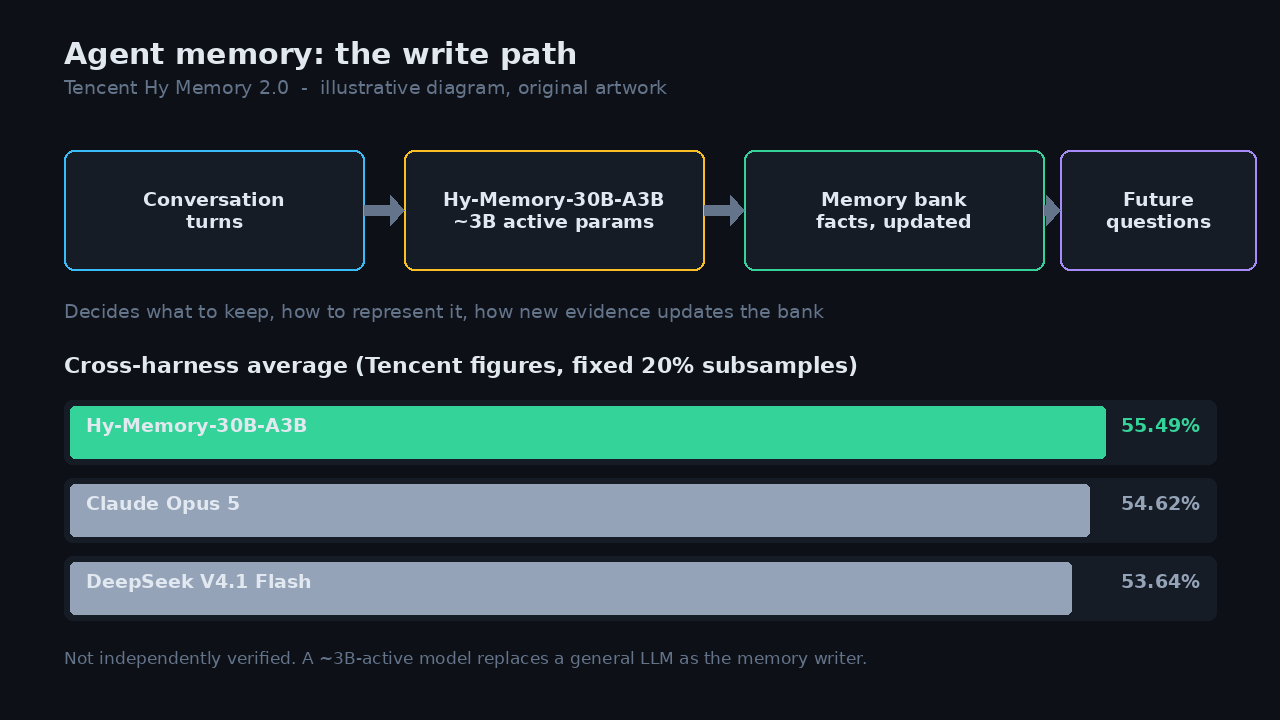
The practical pitch is cost. A 3-billion-active-parameter model doing the writing is far cheaper to run than a flagship general model — and the memory-writing workload is constant: every conversation, every user, every day.
The benchmarks — and what they don't say
Tencent's model card reports a cross-harness average of 55.49%, ahead of Claude Opus 5 at 54.62% and DeepSeek V4.1 Flash at 53.64%. The score averages six benchmarks — including LongMemEval and LoCoMo — across four memory frameworks, each evaluated on a fixed 20% subsample of the test data. These are the company's own numbers; they have not been independently verified.
The honest footnote matters more than the headline. Fixed 20% subsamples, Tencent-chosen harnesses, a Tencent-run evaluation — the setup is designed to show the model at its best. That doesn't make the numbers fake; it makes them a starting point, not a verdict.
The deeper claim is architectural, not numerical: memory-writing is a distinct skill that a small specialist can own. If true, every agent framework gets a cheaper, swappable memory layer — the same instinct behind keeping the inference layer swappable. But a specialist is only as good as its training distribution, which is why the independent check matters.
What the independent test found
On the same week, an independent developer tested the Hy-Memory framework (version 2.0.1) on LongMemEval, focusing on two failures: outdated facts and forgotten attribution. With a cheap model doing the writing, the system answered 43% of 60 questions correctly — and scored 0% on questions whose answers appeared only in what the assistant itself had said.
With Claude Opus 5.5 as the writer, the picture changed: 9 out of 10 on updated facts, matching the tester's own system that uses no LLM at write time. But the price was about $5 per 50-conversation user history — 92 LLM calls and 695,000 input tokens. Quality, the tester concluded, is bought at write time.
The mechanism is the tradeoff. Hy-Memory compresses each conversation into tidy statements about the user — which throws away whatever the writer doesn't consider a fact: the assistant's own recommendations, details that seemed minor, sometimes the newer version of a fact. Keeping raw turns with timestamps avoids the guessing but costs more storage and reading. Neither design is wrong; they fail differently.
The 2.0 suite and how to run it
The three layers are the real product strategy. The model handles the write path, the framework provides the memory machinery, and MemHub shares one memory across tools — each usable alone or together. Everything is Apache 2.0, which means commercial use without the revenue-gated strings attached to some open-weight releases.
Deployment is deliberately boring: install through vLLM (tested with v0.31.0), call an OpenAI-compatible API, point it at your framework. The code lives at github.com/Tencent-Hunyuan/Hy-Memory and the technical report at arXiv 2610.22196.
What it means
For agent builders, the release legitimizes a new division of labor: a cheap specialist writes memory, the big model thinks. That division only pays off if the writer is good enough for your data — which is exactly what the independent test measured.
For the memory-framework landscape — Mem0, MemOS, and friends — a portable, open-licensed writer that transfers across harnesses lowers switching costs. The moat moves from the writer to the retrieval and reconciliation design.
The right response to the 55.49% headline is the tester's checklist: run it on your own conversations, measure which writer you need and what it costs per user, and ask whether it keeps what the assistant said — because 'what did you recommend last time?' is a question real users ask. Open source makes that homework possible; it doesn't do it for you.
Sources and further reading
Source records were reviewed by the owner; no independent factual or model review is claimed.
- Tencent Hunyuan model card (Hugging Face)
Tencent Hunyuan (Hugging Face)
Recorded publication date ·
Recorded verification time ·
- arXiv technical report
arXiv (Tencent Hunyuan)
Recorded publication date ·
Recorded verification time ·
- AlexTech.ai analysis
AlexTech.ai
Recorded publication date ·
Recorded verification time ·
- independent test by dev.to author
DEV Community
Recorded publication date ·
Recorded verification time ·
- Longbridge / Wallstreetcn report
Longbridge (Wallstreetcn)
Recorded publication date ·
Recorded verification time ·